
Understanding abdominal fat in menopause: hormonal causes, metabolic risks and evidence-based strategies to reduce it.
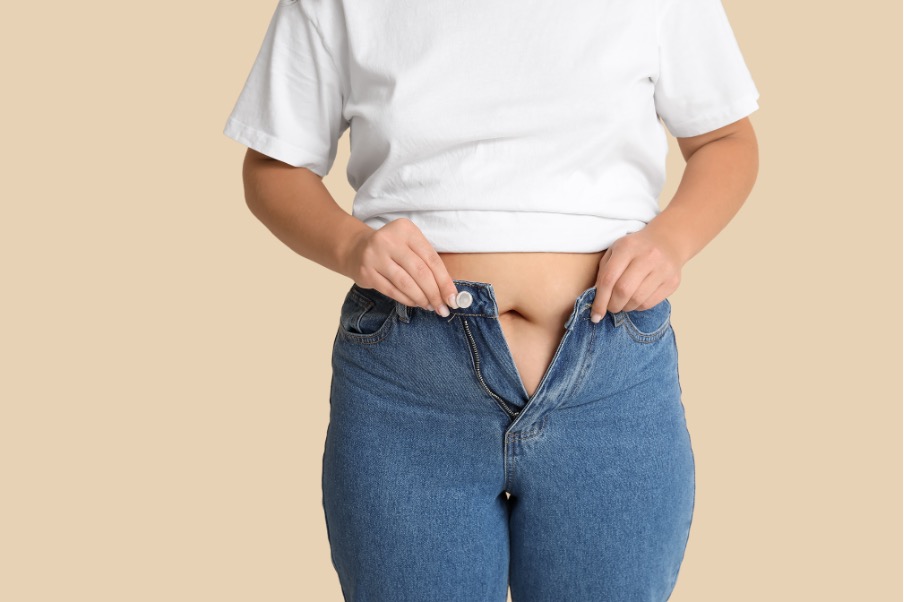
If in recent months you have noticed that your abdomen has changed, that clothes fit differently, that your belly seems to resist anything you try, you are not imagining it. It is real, it is documented, and it has a name: menopause belly.
What nobody often talks about is that this is a signal from your body, a precise biological response to a profound hormonal change. Understanding it is the first step to addressing it effectively, without punitive diets or guilt.
In this article you will find an accessible scientific explanation of the causes, the concrete risks that visceral fat carries, and the strategies that research and the IMS and EMAS guidelines indicate as effective.
What is menopause belly and why is it different
Fat is far from uniform. Throughout the fertile years, oestrogens direct fat deposits towards the hips, buttocks and thighs. This is the so-called gynoid pattern, which is protective from a metabolic point of view.
With the decline in oestrogens that accompanies perimenopause and menopause, this mechanism stops. Fat shifts towards the abdomen, and accumulates mainly as visceral fat — the kind that deposits around the internal organs.
Visceral fat vs. subcutaneous fat
Subcutaneous fat is the kind found just under the skin. Visceral fat surrounds the liver, pancreas and intestines. This second type is metabolically active: it releases inflammatory molecules, interferes with the insulin response and increases cardiovascular and metabolic risk.
Several longitudinal studies confirm that the menopausal transition accelerates intra-abdominal fat deposits independently of ageing. The decline in oestradiol is the primary cause of this redistribution, supported by preclinical evidence showing how the interruption of oestrogenic signalling accelerates fat accumulation, disproportionately in the abdominal area.
The result is a visible change: the belly changes shape, becomes harder, more difficult to modify with the methods that used to work. It is physiology, not a personal failure.
Why you gain weight in menopause: the hormonal causes
The change in fat distribution does not depend only on the decline in oestrogens. It is the result of a series of mechanisms that intertwine, and understanding them helps explain why simplistic solutions do not work.
1. The decline in oestrogens
Oestrogens regulate how the body uses and distributes energy. When they decline, the ratio between testosterone and oestradiol shifts in favour of the former, favouring abdominal fat deposits with characteristics similar to those of men (android pattern).
At the same time, lipolysis in visceral adipose tissue reduces — that is, the ability to mobilise and burn fat in that area. The body, essentially, tends to hold onto abdominal fat.
2. Basal metabolism slows down
Menopause also reduces resting energy expenditure. Studies conducted with direct measurements document a decrease in basal metabolism that coincides with the decline in oestradiol and the onset of the menopausal transition. In practical terms: with the same diet, fat tends to accumulate more easily.
3. Cortisol and stress
Visceral adipose tissue has a higher concentration of cortisol receptors than subcutaneous fat. When cortisol levels chronically rise — and in perimenopause this happens more easily because oestrogens modulate the stress response — fat accumulates preferentially in that area.
The link between stress, cortisol and abdominal fat is documented by several studies, showing that women with higher cortisol levels have greater visceral adiposity, independently of total weight. Interrupted sleep, frequent in perimenopause due to night sweats, also contributes to raising cortisol and worsening the metabolic response.
4. Insulin resistance
According to the EMAS guidelines, among the metabolic changes of the menopausal transition there is also an alteration of insulin sensitivity. Visceral fat produces inflammatory molecules that reduce the cells' response to insulin. This creates a cycle: more visceral fat, more insulin resistance, more difficulty burning fat.
The risks of abdominal fat in menopause
Understanding why visceral fat deserves attention goes well beyond the question of clothes or silhouette. The research is clear on this point.
The IMS World Congress 2024 reiterated that oestrogen deficiency increases cardiovascular risk through visceral adiposity, insulin resistance, and chronic inflammation. These risks begin during the menopausal transition itself.
The accumulation of intra-abdominal fat is associated with:
- • Increased risk of metabolic syndrome
- • Greater likelihood of developing type 2 diabetes
- • Dyslipidaemia (altered cholesterol and triglyceride values)
- • Hypertension
- • Elevated cardiovascular risk
Addressing this aspect has a concrete impact on general health, well beyond physical appearance.
Abdominal bloating and menopause belly: are they the same thing?
-
- Many women in perimenopause report abdominal bloating, a feeling of a bloated and hard belly that varies throughout the day. This is not necessarily visceral fat: it is often water retention, alterations of the intestinal microflora or increased gastrointestinal sensitivity, all changes that oestrogens influence.
- Bloating in menopause and abdominal fat from menopause can coexist, but have different causes and require different strategies. Bloating responds well to dietary interventions (reduction of fermentables, hydration, probiotics) and stress management. Visceral fat requires a more structured approach and, often, a hormonal assessment.
How to reduce abdominal fat in menopause: what the science says
There are strategies with solid scientific evidence that work, when applied in an integrated and personalised way.
Exercise: the type makes a difference
Physical exercise is one of the fundamental pillars, but the type makes a difference. Guidelines and recent literature converge on two elements:
- • Resistance training (weights or bodyweight): this has the greatest impact on body composition in menopause. Counteracting muscle mass loss is essential, because muscle is a metabolically active tissue that helps burn fat, even at rest.
- • High intensity aerobic exercise (HIIT): this has proven effective in specifically reducing visceral fat, with superior results compared to low-intensity aerobics for the same time invested.
An often underestimated aspect concerns spontaneous physical activity: longitudinal studies have documented that with menopause, free physical activity decreases, and the unstructured daily movements. This also contributes to abdominal accumulation, regardless of how much time is spent at the gym.
Nutrition: quality, not just calories
Very restrictive diets in menopause tend to worsen the situation in the medium term, because they accelerate muscle mass loss and increase cortisol levels. The most effective approach supported by research is one that focuses on nutritional quality, not just calorie deficit.
Elements with the strongest evidence:
- • Adequate protein: the ESCEO guidelines recommend an intake of 1.0-1.2 g/kg of body weight per day for women in perimenopause and menopause, distributed across main meals, to preserve muscle mass. Research shows that women in menopause tend spontaneously to reduce protein intake, with negative effects on body composition.
- • Reduction of simple sugars and refined carbohydrates: these contribute to increasing insulin resistance, which tends to worsen in menopause.
- • Good fats and anti-inflammatory foods: extra virgin olive oil, oily fish, nuts, seasonal vegetables.
- • Attention to alcohol: even moderate amounts contribute to abdominal fat deposits and worsen sleep quality, already compromised at this stage.
-
Stress and sleep management
As we have seen, cortisol and visceral fat feed on each other. Reducing chronic stress has measurable biological effects on body composition. Mindfulness techniques, diaphragmatic breathing, yoga, and adequate sleep contribute to regulating the HPA axis (hypothalamus-pituitary-adrenal), reducing the chronic cortisol response.
It is worth dwelling on sleep: the night sweats typical of perimenopause interrupt deep sleep cycles, which is the moment when the body regulates cortisol levels and restores insulin sensitivity. Treating vasomotor symptoms, when present, therefore has an indirect but concrete impact on body composition too.
The role of hormone replacement therapy (HRT)
Menopausal hormone therapy (MHT) is often cited in relation to weight, with widespread fears that it may cause weight gain. The scientific evidence tells a different story.
What the evidence says on MHT and abdominal fat:
The majority of studies evaluating the effect of hormone therapy on body composition show a reduction in central fat in women who use it, compared to those who do not. The OsteoLaus study (2018, Oxford University Press) on over 1,000 postmenopausal women documented a significant association between MHT use and lower total and visceral adiposity.
The Korean Society of Menopause guidelines (2025) confirm that MHT contributes to reducing abdominal fat deposits and improving metabolic and musculoskeletal health indicators.
In summary, MHT can help preserve a favourable body composition, acting on the underlying hormonal cause
It is important to be clear: MHT is a medical treatment that requires individual assessment. It is not indicated for everyone, and the decision must be made together with a specialist who knows your clinical history, risk factors and symptoms. But when indicated, the evidence shows it can be an integral part of a strategy for metabolic health in menopause
Why menopause belly does not resolve on its own
One of the most frequent questions is: will it pass? The redistribution of fat that occurs with menopause tends to stabilise over time, but reversing it requires a specific intervention. The situation is modifiable. It requires an active, informed approach, supported by professionals who understand the physiology of this phase.
The good news, supported by science, is that women who combine resistance training, adequate protein intake, stress management and, when indicated, hormone therapy, achieve concrete results on body composition. Not in weeks, but in months. With consistency and the right support.
Where to start
If you recognise the signs described in this article, the first useful step is to understand what is happening in your body at a hormonal and metabolic level. A specialist assessment can help you:
- • Understand which phase of the menopausal transition you are in
- • Assess whether there is a hormonal component that can be treated
- • Build a personalised plan on exercise, nutrition and, if indicated, hormonal support
- • Monitor body composition over time, not just the number on the scale
-
Tell us about your case — free consultation with a Pausetiv consultant
Sources and scientific references
This article is based on evidence from peer-reviewed literature and international guidelines, including:
- IMS White Paper 2024 (Panay et al., Climacteric 2024)
- State of the Art IMS World Congress 2024 (Simon et al., Climacteric 2025)
- EMAS Clinical Guide on menopause and diabetes (Maturitas 2018)
- OsteoLaus Cohort study on MHT and body composition (JCEM 2018)
- Korean Society of Menopause Guidelines 2025
- Review on healthy adipose tissue in postmenopause (Exploration of Medicine, March 2025)
- Study on subcutaneous and visceral adipose tissue in menopause (Scientific Reports, 2021)
- ESCEO recommendations on protein and vitamin D in postmenopause (Rizzoli et al., Maturitas 2014)
Dicsclaimer: The information in this article is for educational and informational purposes only. It does not replace individual medical assessment.