.jpeg)
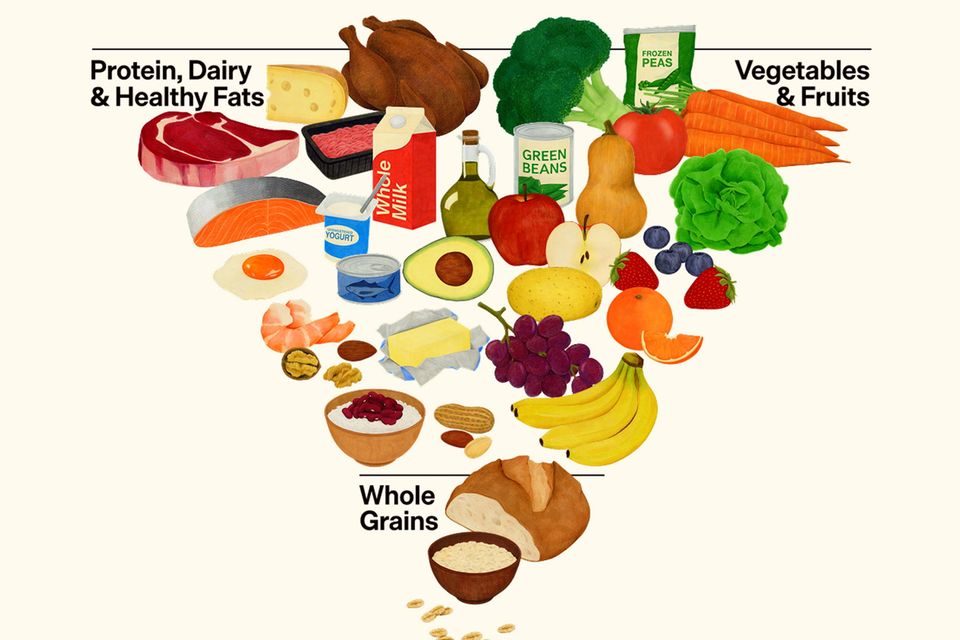

In the United States, a new version of the Dietary Guidelines has recently been presented, together with a food pyramid that has sparked wide debate, also because of the strong communicative message that accompanies it: less sugar, fewer ultra-processed foods, more protein, more “real food.”
At first glance, some of these principles seem to be moving in the right direction. However, when it comes to women’s health, and particularly to perimenopause and menopause, it is essential to go beyond slogans and carefully assess how, and for whom, this model may actually be appropriate.
Menopause is not simply a “hormonal phase,” but a complex biological transition that affects metabolism, muscles, bones, the cardiovascular system, and the brain. For this reason, any nutritional guidance must be interpreted in light of these specificities.
What the new food pyramid proposes
The new American approach focuses on a few key concepts: a drastic reduction in added sugars and ultra-processed foods, an increase in daily protein intake, and a re-evaluation of foods such as dairy products (including full-fat options) and animal protein sources. Refined carbohydrates are strongly reduced, while attention shifts from simple calorie counting to food quality.
This represents a change of direction compared with earlier “low-fat” models. Some elements are supported by solid scientific evidence; others, if applied without personalization, may present critical issues, especially during menopause.
Reducing ultra-processed foods: a solid foundation in menopause as well
One of the most convincing aspects of the new pyramid is the emphasis on reducing ultra-processed foods. This term refers to industrial products formulated with refined ingredients, added sugars, low-quality fats, salt, and additives, and typically poor in fiber and micronutrients.
In recent years, numerous systematic reviews have shown a consistent association between high consumption of ultra-processed foods and an increased risk of cardiovascular disease, type 2 diabetes, obesity, metabolic disorders, and all-cause mortality.
During menopause, this issue becomes particularly relevant. The decline in estrogen levels is associated with a greater tendency toward visceral fat accumulation, worsening insulin sensitivity, and increased low-grade inflammation. Reducing ultra-processed foods therefore means addressing one of the main environmental factors that amplify these physiological changes.
More protein: why it truly matters after 40–50
Another central message of the new pyramid is the increase in protein intake. This point deserves particular attention, especially in relation to sarcopenia.
Sarcopenia is the progressive loss of muscle mass and strength associated with aging. It is not merely an aesthetic issue: muscles are metabolically active organs, and muscle loss is associated with reduced basal metabolic rate, increased risk of falls and fractures, loss of autonomy, and poorer quality of life. After menopause, this risk increases, partly due to the interaction between hormonal changes and reduced physical activity.
Recent evidence suggests that, in menopausal women, a protein intake higher than the minimum recommendation (0.8 g/kg/day) may be beneficial. Many studies indicate a reasonable range of approximately 1.0–1.2 g of protein per kilogram of body weight per day, particularly when combined with resistance training.
However, it is important to emphasize that the benefit does not depend solely on quantity, but also on protein quality, distribution across meals, and the overall dietary context.
When “more protein” becomes a misleading message
The most controversial aspect of the new pyramid concerns the prominent role given to red meat, full-fat dairy products, and animal-derived fats. If interpreted in an overly simplified way, this message may lead to increased intake of saturated fats and processed meats.
Scientific evidence shows that processed meats are convincingly associated with an increased risk of cancer, particularly colorectal cancer. High and frequent consumption of red meat has also been associated with increased cardiovascular risk.
During menopause – a phase in which estrogen’s protective effect on the cardiovascular system declines, this issue becomes even more relevant. A diet excessively rich in saturated fats may contribute to higher LDL cholesterol levels and increased cardiometabolic risk, especially in women with family history or pre-existing risk factors.
Saturated fats and the limits of the infographic
Visually, the base of the new pyramid highlights full-fat dairy products, butter, and animal protein sources rich in saturated fats. This visual message may be misleading, particularly because it contrasts with the recommendation, included in the written guidelines,to limit saturated fat intake to less than 10% of total energy.
Visual communication often outweighs written explanations. The risk is that habitual and abundant consumption of these foods may be perceived as inherently protective, without consideration of individual context.
In menopause, responses to saturated fats vary widely and depend on each woman’s metabolic and cardiovascular profile. The issue, therefore, is not the single food, but the absence of clear hierarchy and explicit encouragement toward personalization.
The absence of physical activity: a relevant limitation
One striking aspect of the new pyramid is what is entirely missing: movement. The guidelines focus exclusively on nutrition, as if food alone could independently influence weight, metabolism, and overall health.
This omission is particularly significant in menopause. Nutrition and physical activity act synergistically on glycemic regulation, insulin sensitivity, low-grade inflammation, cardiovascular health, maintenance of muscle mass and bone density, circadian rhythm regulation, sleep quality, and psychological well-being.
In menopause, physical activity, especially resistance training and regular movement, is not an optional complement, but an essential component of prevention. Excluding it from a nutritional model risks conveying an incomplete and unrealistic message.
Food quality: beyond “no ultra-processed foods”
Another limitation of the new pyramid lies in its narrow definition of food quality. Avoiding ultra-processed foods is a valid starting point, but it cannot be the only criterion, particularly in the European and Mediterranean context.
In the Mediterranean model, food quality also includes seasonality, variety and biodiversity, environmental sustainability, food origin, regular meal patterns, adequate hydration, and the social dimension of eating. These elements are not cultural add-ons, but factors that concretely influence metabolic health, hormonal balance, and psycho-emotional well-being.
During menopause, when the relationship with the body and food may become more fragile, this broader concept of quality becomes even more important.
Sugars, insulin resistance, and fiber: a key metabolic issue
One of the most relevant and often underestimated aspects of nutrition in menopause concerns the relationship between sugars, glycemic regulation, and insulin resistance.
Insulin resistance refers to a condition in which the body’s cells respond less effectively to insulin, the hormone that allows glucose to enter cells to be used as energy. When this response is reduced, the pancreas must produce more insulin to keep blood glucose within normal ranges. Over time, this mechanism can promote weight gain, visceral fat accumulation, and deterioration of metabolic health.
During perimenopause and menopause, declining estrogen levels contribute to changes in glucose metabolism and insulin sensitivity. Recent studies show that estrogen reduction is associated with greater glycemic variability and increased risk of developing insulin resistance, even in women who were previously metabolically healthy.
In this context, the quality and quantity of sugars consumed become key factors. Simple, rapidly absorbed sugars lead to sharper glycemic and insulin peaks, which over time can worsen insulin sensitivity.
Dietary fiber plays a crucial role here. Fiber slows carbohydrate absorption, modulates glycemic response, increases satiety, and supports the gut microbiota. In menopause, adequate fiber intake is associated with improved lipid profile, reduced cardiovascular risk, and better metabolic health.
Why the Mediterranean diet remains the most solid model
In the Pausetiv protocol, we continue to consider the Mediterranean diet the most recommended nutritional model for menopause.
The Mediterranean diet is neither a low-protein nor a low-fat diet. It is a balanced model that integrates proteins from different sources, fiber-rich complex carbohydrates, and predominantly unsaturated fats, with moderate and mindful consumption of animal-based foods.
Recent evidence shows that high adherence to the Mediterranean diet is associated with reduced cardiovascular risk in postmenopausal women, improved metabolic control, and support for bone and muscle health. Adapting the Mediterranean diet by slightly increasing protein intake and optimizing meal distribution represents one of the most coherent and sustainable strategies for health in midlife.
Conclusion
The new American food pyramid raises important and partly shared points, particularly the need to reduce sugars and ultra-processed foods and to pay greater attention to protein intake.
However, for women in menopause, it cannot be adopted rigidly or uncritically. Health in this phase requires a personalized approach that takes into account metabolic, cardiovascular, and skeletal health, physical activity, food quality, and overall lifestyle.
The Mediterranean diet, updated and adapted to the needs of menopause, remains today the model most strongly supported by scientific evidence and most consistent with a long-term vision focused on quality of life and prevention.
Find out more about Pausetiv's nutritional treatment plans here.
Sources
1. Lane MM et al. (2023): Ultra-processed food consumption and health outcomes: umbrella review The BMJ https://www.bmj.com/content/380/bmj-2022-072277
2. World Cancer Research Fund / AICR (2023): Diet, Nutrition, Physical Activity and Cancer: a Global Perspective
https://www.wcrf.org
3. Phillips SM, Fulgoni VL (2024): Assessment of protein needs in aging women. Advances in Nutrition
https://academic.oup.com/advances
4. European Menopause and Andropause Society – EMAS (2023–2024): Lifestyle, diet and metabolic health in menopause
https://emas-online.org
5. Kesse-Guyot E et al. (2023): Mediterranean diet and cardiometabolic health in postmenopausal women. Nutrients
https://www.mdpi.com/journal/nutrients
6. Nature Metabolism (2023): Estrogen deficiency and metabolic adaptations
https://www.nature.com/natmetab
7. Gambacciani M, Levancini M. (2023): Metabolic syndrome and menopause: a narrative review. Climacteric
https://www.tandfonline.com/doi/full/10.1080/13697137.2023.2183709
8. EMAS Position Statement (2023): Lifestyle interventions for metabolic health in menopause. Maturitas
https://www.sciencedirect.com/science/article/pii/S0378512223002100
9. Reynolds A et al. (2024): Dietary fibre and cardiometabolic health: updated systematic review. The Lancet
https://www.thelancet.com
10. Barrea L et al. (2023): Mediterranean diet, insulin resistance and menopause. Nutrients
https://www.mdpi.com/journal/nutrients